I said I love. That’s the promise the T-Video politics of Jean-Luc Godard
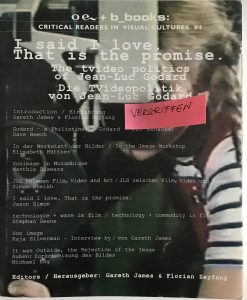
Gareth James and Florian Zeyfang, eds. I said I love. That’s the promise the TVideo politics of Jean-Luc Godard. Berlin: b_books, 2003.
Book information:
I said I love. That is the promise. The TVideo politics of Jean-Luc Godard< focuses on the filmmaker’s often neglected work with television and video and his collaboration with Anne-Marie Miéville in the 1970s. The starting point is the thesis that Godard’s encounter with television reformulated the aesthetic, political and gender-specific understanding of image and sound. What is called ‘TVideopolitik’ here derives its political power from the fact that it takes images from an economy of reproduction and recognizes their function in an economy of production and distribution. The papers analyze film, television and art as practices of representation and claim that Godard’s turn to television involves “provocation: what it is to see and to think”.
With texts by: Kaja Silverman, Elisabeth Büttner, Dave Beech, Manthia Diawara, Simon Sheikh, Jason Simon, Stephan Geene and Michael Eng as well as pictures from an exhibition.
For more information: https://www.bbooks.de/verlag/i-said-i-love-thats-the-promise
Rebecca Belmore: The Named and the Unnamed
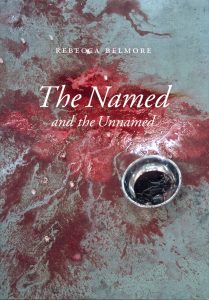
Charlotte Townsend-Gault and James Luna. Rebecca Belmore: The Named and the Unnamed. Vancouver, BC: Morris and Helen Belkin Art Gallery, 2003
Book information:
Exhibition catalogue from the Morris and Helen Belkin Art Gallery (4 October–1 December 2002).
Texts by Scott Watson, Charlotte Townsend-Gault and James Luna.
For more information: https://belkin.ubc.ca/publications/rebecca-belmore-the-named-and-the-unnamed/
“I Love You” in Gillian Wearing: A Trilogy
Marina Roy, “I Love You” in Gillian Wearing: A Trilogy. Vancouver, BC: Vancouver Art Gallery, 2002
Book information:
In her documentations of contemporary social life, Gillian Wearing brings viewers into direct contact with the poignancy of human relationships: sensitive connections based on love, entanglements fraught with dysfunction and abuse or, more likely, associations that embody the utter complexity of human psychology. This book documents the first solo exhibition of Gillian Wearing’s work in Canada and brings together a trilogy of her video installations: Drunk, I Love You and Prelude.
Gillian Wearing: A Trilogy was published on the occasion of an exhibition organized by the Vancouver Art Gallery, curated by Daina Augaitis with assistance from Melanie O’Brian, and presented from July 13 to October 27, 2002.
Edited Daina Augaitis
Essays by Daina Augaitis, Mark Beasley, Russell Ferguson, Marina Roy
Germaine Koh

This book was published in 2001 by the Contemporary Art Gallery on the occasion of the exhibition, Germaine Koh at the the Contemporary Art Gallery in its new facility at 555 Nelson Street, May 4 – July 14, 2001. This publication features a forward by Keith Wallace, and essay “Immanent Domain” by Laura U. Marks.
For more information: https://cagvancouver.org/shop/product/germaine-koh-publication
Sign after the x

“X” is one of the most provocative representations in contemporary culture: a symbol of capital, power, waste, and illicit desire. Based on the connection between language and the lack thereof, Sign after the x investigates the letter “X” that is used in our culture as part of a complex sign system that encompasses the evolution of language back to its mythic origins. Copublished by Artspeak gallery, Vancouver.
Including many of her drawings, Marina Roy uses narrative–and the book conventions of the dedication, preface, introduction, postscript, errata, and index–to form a compendium of X words that is part philosophical treatise on the foundations of image and text, part illustration, part math lesson, and part language primer.
For the author, the combination of text and image arises from a desire to make words “flesh” as it were, a desire to treat text as a thing that, in its visual impact, and in its arbitrary association with everyday objects, creates new meaning, leading to revelations about “how myth is constructed in our culture. ”
Beguiling in its ambitions, Sign after the x is a subjective, subversive dictionary of modern culture that forces readers to see the world in a new light.
For more information: https://arsenalpulp.com/Books/S/Sign-After-the-X
Drowning
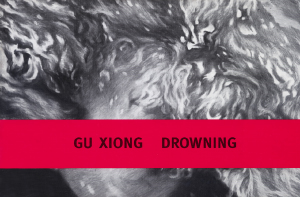
A 17-page catalogue published by the Richmond Art Gallery, Richmond, BC, featuring Gu Xiong’s solo exhibition.
In Drowning, an expanded version of the exhibition, The Mirror; A Return to China (Yukon Art Centre, 1999), Gu Xiong poetically links the personal trauma of this boating accident, in particular the near drowning of his daughter Gu Yu, with his sense that his hometown, and by extension the China he grew up in, is being “drowned,” obliterated by the mammoth construction projects and the country’s colonization by Western culture and business. In thirty-six framed photo works and two photo murals that make up the bulk of the installation, he documents and reflects on this transformation, presenting such potent views as workers among piles of rubble, a Marlboro cigarette billboard stretched across a Chongqing pedestrian overpass, hovering above dense traffic, and a classic tourist snapshot of himself before a miniature version of Mount Rushmore (from a theme park in Chongqing which also housed a model of the Titanic). His images also include such charged scenes as Gu Xiong standing before a monument and soldier in Tiananmen Square.
For more information: http://guxiong.ca/en/solo-exhibition/drowning/
Ding Ho, Group of 7
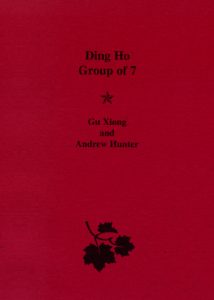
Andrew Hunter and Gu Xiong, Ding Ho, Group of 7. Kleinburg, ON: McMichael Canadian Art Collection, 2000
Book information:
A 60-page catalogue published by McMichael Canadian Art Collection, featuring Gu Xiong’s mixed media installation in collaboration with Andrew Hunter.
This collaborative installation by Vancouver artist Gu Xiong and Dundas, Ontario-based artist and curator Andrew Hunter includes artworks, family photos, and artefacts from the Cultural Revolution and Chinese/Canadian restaurants exhibited alongside paintings by the Group of Seven. In Ding Ho/Group of 7, the lines between artworks, artefacts, and common objects are blurred and the traditional authoritative ‘voice of the institution’ and official history are challenged.
In Andrew Hunter’s words, “For Gu Xiong and I, this project is about dialogue and change, about rethinking one’s past and seeing it through the eyes of another, about movement and migration (both physical and philosophical) and the constant struggle to form a sense of identity that is a hybrid of many identities. Ding Ho/ Group of 7 is about being Canadian.”
For more information: http://guxiong.ca/en/solo-exhibition/ding-ho-group-of-seven/