Germaine Koh: Shell

Shell was a situation in which part of an existing windowed storefront is physically opened to the public, for use 24 hours a day. An enclosure resembling a transit shelter was built on the inside of the space, attached to the existing glass frontage, a pane of which was removed in order to create free access to the new structure from the street. Now given over to the public sphere, the area inside the shelter became an in-between, layered space. It offered shelter, but uneasily, remaining part of the interior space while serving as a recognizable public form (bus shelter). It also exposes the vulnerability of the private space — not so much for the physical breach (which is only a matter of square metres lent), but more through our recognizing the fragility of our notions of safety, property, and propriety.
For more information: https://germainekoh.com/works/shell/
Germaine Koh: Works

Transference, Tradition, Technology: Native New Media Exploring Visual and Digital Culture

Dana Claxton, Steven Loft, and Melanie Townsend. Transference, Tradition, Technology: Native New Media Exploring Visual and Digital Culture. Banff, Alta.: Walter Phillips Gallery Editions, 2005
Book information:
Transference, Tradition, Technology explores Indigenous new media and references the work of artists within a political, cultural and aesthetic milieu. The book constructs a Native art history relating to these disciplines, one that is grounded in the philosophical and cosmological foundations of Indigenous concepts of community and identity within the rigour of contemporary arts discourse. Approachable in nature but scholarly in content, this book is the first of its kind. A text book for students and teachers of Indigenous history and visual and media art, and a source for writers, scholars and historians, Transference, Tradition, Technology is co-produced with the Art Gallery of Hamilton, Hamilton; and Indigenous Media Arts Group, Vancouver.
For more information: https://artmetropole.com/shop/14334
Germaine Koh: Stall
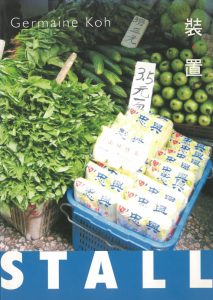
Established but young Asian Canadian artist has developed sensitivity to different cultures through her extensive exhibition career in different countries. Her work addresses issues of subtle perceptions of different situations and the politics of everyday life. She develops new work in response to the physical site of Para Site Art Space and the social-cultural situation of Hong Kong. has exhibited in international biennales in Montreal and Sydney.
, an internationally acclaimed visual artist from Canada, exhibit STALL at Para Site Art Space. has exhibited extensively in solo and group exhibitions throughout Europe, Canada, USA, Australia, Asia and Mexico. Her conceptually-driven works are informed by her observations of everyday life, familiar objects, and common places. STALL is a combination of several installation works, including new site-specific pieces, offering an interesting look at the interconnected relationship between various types of commercial transactions.
In the work, Stall, grass sprouting from wooden stepped structures resembling market stands occupy the gallery, whereby the unevenness of grass catches the natural ambience of the space. While making reference to commercial cycles of production and consumption, Stall takes the gallery space out of that cycle of urgency, in favour of a natural process of organic growth.
A new installation, involving hundreds of recycled bottles constructed in a formation uniquely pertinent to the cityscape of Hong Kong occupies the first floor gallery.
Each of these exciting works, which references various types of commercial transactions, distills an action or a movement. By slowing down the processes of transaction, STALL reveals a different time scale; one that is organic, quiet, and relaxing, shown in marked contrast to the demanding pace of the commercial nature of the world we live in. Each work will surprise the viewers in an unexpected twist by slowing down or drawing out each of these processes.
For more information: http://www.para-site.art/exhibitions/germaine-koh-stall/
Here is what I Mean
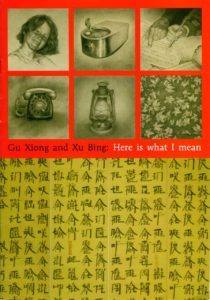
Gu Xiong and Xu Bing. Here is what I mean. London, ON: Museum London, 2004
Book information:
A 15-page catalogue published by the Museum London, London, ON, featuring Gu Xiong and Xu Bing’s collaborative exhibition.
Gu Xiong and Xu Bing are compatriots from the People’s Republic of China who shared experiences through the Cultural Revolution and the development of the Chinese Avant-Garde movement in the 1980s. Each subsequently emigrated to North America: Gu Xiong to Canada (where he now lives in Vancouver) and Xu Bing to New York.
The exhibition includes part of Xu Bing’s acclaimed Book from the Sky – in which the artist has created hundreds of artificial Chinese characters and printed them in books and on scrolls – as well as calligraphy scrolls, a classroom installation and an interactive computer font project. Gu Xiong contributes an installation of sixteen square drawings on canvas, which report on everyday objects and events encountered in his immigrant experience, and several large-scale paintings where text-like images describe the artist’s view of the detritus of Western consumer culture.
For more information: https://dorismccarthygallery.utoronto.ca/exhibitions/here-is-what-i-mean