Image Bank
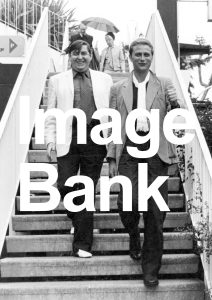
Image Bank explores the artistic collaboration of Michael Morris, Vincent Trasov and originally Gary Lee-Nova, including their most spectacular works – extended performances with props, such as Colour Bar Research (1970-78) and Mr. Peanut’s mayoralty campaign (1974) in which Vincent Trasov as Mr. Peanut ran for mayor of Vancouver – alongside their extensive mail-art exchanges with other networkers such as Robert Filliou, General Idea, Ant Farm and Ray Johnson’s New York Correspondence School. The catalogue is published on the occasion of the Image Bank exhibition at KW Institute for Contemporary Art, Berlin (June 22-September 1, 2019) and the Morris and Helen Belkin Art Gallery, University of British Columbia, Vancouver (January to April 2021), curated by Krist Gruijthuijsen, Maxine Kopsa and Scott Watson. Critical essays explore the compelling history of Image Bank and the mail-art network in which they performed: Hadrien Laroche revisits Babyland, an important rural “set” for Image Bank performances; Felicity Tayler examines the artists’ directories as a new form of kinship and community; Zanna Gilbert considers Image Bank’s postcard exhibition in the context of mail-art exhibitions; AA Bronson’s important text “Pablum for the Pablum Eaters” is reprinted from General Idea’s FILE Megazine; Angie Keefer writes of how we might think about networks in general; and co-curator Scott Watson defines the beginning and end of Image Bank and its legacy both locally and internationally. Interviews with the artists Michael Morris, Vincent Trasov and Gary Lee-Nova provide insight into the personalities of Image Bank. Through words and images, Image Bank reflects on a period of optimism where artists envisioned a non-hierarchical alternative to the world of art galleries and museums, where images and ideas could be freely exchanged through the international postal system thereby creating an open-ended and decentralized method of networking that presages social media.
For more information: https://www.hatjecantz.de/image-bank-1969-1977-7617-1.html
Woven Work From Near Here
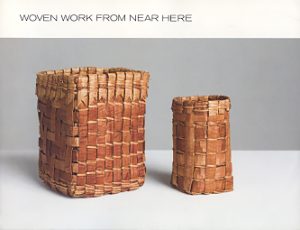
Emily Hermant and T’ai Smith, Woven Work from Near Here. Vancouver, BC: grunt gallery, 2018
Inspired by traditional weaving practices—including Indigenous methods for weaving blankets and baskets alongside structures and patterns that have come from elsewhere—the exhibition presents recent experiments by artists who live and work near here. Juxtaposing materials and methods, the works in the show stretch what it means to be a woven textile.
The curators understand being “near here” as a spatial and temporal condition that defines the region currently known as the Pacific Northwest—a mesh of overlapping Indigenous and Settler cultures, legal-political systems, and territories. To live, work, and weave near here is to contend daily with the legacy of colonial settlement and expropriation. Marked by the dislocation of Indigenous weaving traditions between the early decades of the 20th century and the 1980s—decades after the Potlatch ban in Canada was lifted in 1951—the region has seen the re-emergence of this conceptual, functional, aesthetic and spiritual form. At once capacious and precise, new developments in weaving signal the potential of this practice to realign protocols and values.
Included in the show are works by artists Debra Sparrow or θəliχʷəlʷət, Gabrielle L’Hirondelle Hill, Hank Bull, Jovencio de la Paz, Kerri Reid, Matt Browning, Melvin Williams, and Merritt Johnson.
For more information: https://grunt.ca/exhibitions/woven-work-from-near-here/
Fringing the Cube
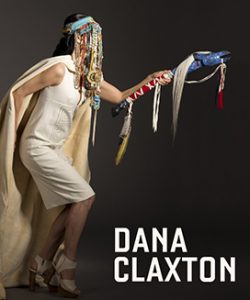
Known for her expansive multidisciplinary approach to art making Vancouver-based Dana Claxton, who is Hunkpapa Lakota (Sioux), has investigated notions of Indigenous identity, beauty, gender and the body, as well as broader social and political issues through a practice which encompasses photography, film, video and performance.
Rooted in contemporary art strategies, her practice critiques the representations of Indigenous people that circulate in art, literature and popular culture in general. In doing so, Claxton regularly combines Lakota traditions with “Western” influences, using a powerful and emotive “mix, meld and mash” approach to address the oppressive legacies of colonialism and to articulate Indigenous world views, histories and spirituality.
This timely catalogue is the first monograph to examine the full breadth and scope of Claxton’s practice. It is extensively illustrated and includes essays by Claxton’s colleague Jaleh Mansoor, Associate Professor in the Department of Art History, Visual Art & Theory at the University of British Columbia; Monika Kin Gagnon, Professor in the Communications Department at Concordia University, who has followed Claxton’s work for 25 years; Olivia Michiko Gagnon, a New York–based scholar and doctoral student in Performance Studies; and Grant Arnold, Audain Curator of British Columbia Art at the Vancouver Art Gallery.
This exhibition is presented by the Vancouver Art Gallery: October 27, 2018 – February 3, 2019.
Essays by Grant Arnold, Monika Kin Gagnon, Olivia Michiko Gagnon and Jaleh Mansoor
For more information: https://shop.vanartgallery.bc.ca/products/dana-claxton-fringing-the-cube
An Exhibition Never Opened
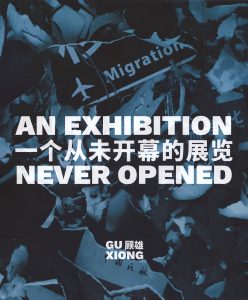
Gu Xiong: Migrations (https://ahva.ubc.ca/publications/guxiong-migrations/) was originally produced to accompany a forty-five-year retrospective organized by the Galaxy Museum of Contemporary Art (Chongqing, China, June 10–August 11, 2017) that was shut down before it officially opened and the catalogues were seized. The publication An Exhibition Never Opened documents these events and includes new writings.
For more information: http://interiormigrations.com/gu-xiong-migrations/